First Grade Skills Map

An Aussie teaching American phonemes

A woman smiles in a portrait overlaid on an illustrated open book with a ladybug, web, and green landscape, reflecting an interactive teaching style; a speech bubble shows "/u/".

Ever heard of bidialectalism? It means the ability to fluently switch between two dialects.
It was a new word for me when I first started teaching in the U.S.—but I figured it out fast, just by opening my mouth in the classroom.

Bringing my own Australian dialect to teaching six-year-olds deepened my capacity to help struggling readers and multilingual readers. It has also strengthened our classroom community and provided surprising, even amusing opportunities to learn—for all of us.

“What if they get an Australian accent?”

When I first entered an American classroom, I was nervous about teaching phonemes to kids. I kept wondering, “What if they get an Australian accent?” (That never happened.)

I remember my first year teaching Amplify CKLA, standing in front of my students and trying to figure out why the word “from” seemed tricky. For me, it sounded exactly how it was spelled. I kept saying “from,” but my students said: “/f/ /r/ /u/ /m/.”

That was the first of many times I realized how different my dialect really was.

The next one came during our Animals and Habitats unit. We were deep into the lesson when I casually said what sounded like “Pythin,” and a student turned and said, “Don’t you mean PythOn?”

Then came the r-controlled vowels. (R-controlled vowels, also called r-influenced vowels, are vowels that change their sound when followed by an “r” in the same syllable. Instead of sounding short or long, the vowel is “controlled” by the “r”—like in “car,” “bird,” “corn,” “turn,” and “her.”)

Because of my accent, when I said those sounds, they almost always came out as “uh.” (I think that’s why I’ve been told Aussies were responsible for the schwa!) While that got a good laugh—and gave students lots of chances to mimic my accent—it drove home the real importance of phonological awareness.

Learning together: Teaching phonemes and pronunciation

I spent the rest of that first year going over the phoneme videos on the Amplify resources hub, practicing my r-controlled vowels. I did my best to learn to switch between the Australian and American dialects. I even started challenging my students to correct me more often. (“Wait, did I say that right?”)

That led to more intentional practice when teaching grade-level spelling patterns for those individual sounds. I started adding silly actions to go with each one. For example, we’d say, “‘e’ and ‘r’ are friends and together they go ‘errrrr,’” and we’d pretend to turn a key into either side of our cheeks.

Those small quirks helped my students remember the sounds—and they helped me just as much.

Don’t dread it—use it!

So, to any teacher who’s dreading teaching phonemes or teaching kids to read because of their speech or dialect—don’t!

Learning with your students, blending Amplify’s tools with your own quirks and personality, builds classroom memories and creates powerful literacy instruction.

You don’t have to erase your accent to be effective. In fact, embracing your uniqueness might just make you a better teacher.

From one teacher to another: Don’t be afraid of the greatness you already have.

To close out, here’s my favorite use of what I believe is the greatest phoneme/diphthong of all time: Aussie! Aussie! Aussie! Oi! Oi! Oi!

Scope and Sequence for Lectoescritura

Amplify Caminos is grounded in the Science of Reading and offers a powerful, evidence-based instructional approach.

The new Lectoescritura Strand specifically teaches students the decoding skills needed for independent reading. Each lesson begins with a warm-up that reviews previously taught content in phonics, reading, grammar, writing, and spelling.

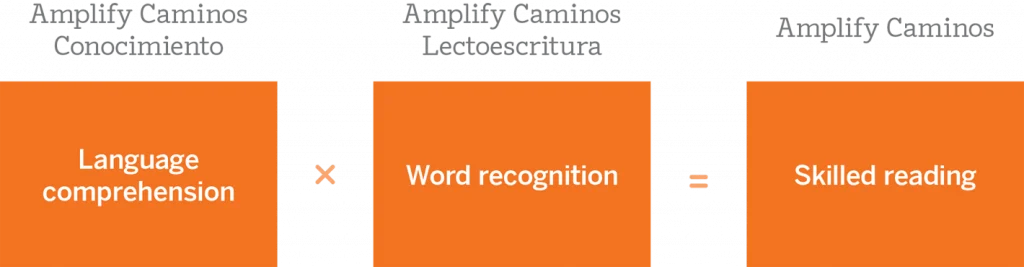
A diagram showing "Language comprehension" times "Word recognition" equals "Skilled reading," with headings in Spanish above each term.

Foundational skills year by year

By building a solid foundation of phonological awareness and phonics, students will learn the sounds of vowels and common consonants first, and blend them to form syllables. Syllables will also be blended to form words. Less frequent consonants and other complex elements of the Spanish language will be presented at a later stage of the program.

A chart shows language skill categories by grade, with dots indicating focus areas for each grade from Kindergarten to Grade 5 in four categories: Print Concepts, Phonological Awareness, Phonics and Word Recognition, and Grammar.

Kindergarten

In Kindergarten, students develop reading comprehension, writing, listening and speaking, language, and foundational skills in the following ways:

  • Reading comprehension: Students answer literal, evaluative, and inferential story questions. Halfway through Kindergarten, students move from whole class reading instruction in Big Books to teacher guided independent and partner reading in decodable Student Readers, still using the Big Book as a model and support.
  • Writing: As students learn new sounds, they will also learn the phoneme to grapheme correspondence of each. The embedded activities and Activity Book provide a daily opportunity to practice the formation of individual letters, syllables, words and eventually sentences that contain the sound being taught in each lesson. In later units, students are guided through the Plan-Draft-Edit writing process.
  • Listening and speaking: Students engage in a range of whole group, small group, and partner discussions about text and daily lesson content.
  • Language: Students receive explicit instruction that introduces vocabulary and common words, or palabras comunes, to support decoding. Instruction also includes attention to the conventions of Spanish, including the use of question words, prepositions and plural nouns in oral speech, as well as capitalization and end punctuation in writing.
  • Foundational skills: Students begin with awareness of vowels and the most frequent consonant sounds, then practice blending those sounds into syllables, then blend those syllables into words with the ultimate goal of reading multisyllabic (2-3) words and complete sentences.

Click to take a closer look at the Kindergarten Scope and Sequence.

Grade 1

In Grade 1, students develop reading comprehension, writing, listening and speaking, language, and foundational skills in the following ways:

  • Reading comprehension: Students answer literal, evaluative, and inferential questions, including textual citations, and read with increasing independence and expression of individual interpretation of text. Reading instruction utilizes both the Student Reader and Big Book until Unit 5 when students transition into solely using the Student Reader.
  • Listening and speaking: Students engage in a range of whole group, small group, and partner discussions about text and daily lesson content.
  • Language: Students receive explicit instruction that introduces vocabulary and common words, or palabras comunes, to support decoding. Students also work to increase the use of new vocabulary in their written responses. In addition, discussions require the use of words in context. Explicit grammar instruction includes using parts of speech, such as nouns and verbs, and different forms of sentences, tenses, and punctuation.
  • Foundational skills: Students review vowels and the most frequent consonant sounds and are introduced complications like multisyllabic words, digraphs, accents, diphthongs, and hiatus.

Click to take a closer look at the Grade 1 Scope and Sequence.

Grade 2

In Grade 2, students develop reading comprehension, writing, listening and speaking, language, and foundational skills in the following ways:

  • Listening and speaking: Students engage in a range of whole group, small group, and partner discussions about text and daily lesson content.
  • Language: Students receive explicit instruction that introduces vocabulary and common words, or palabras comunes, to support decoding. Students also work to increase the nuanced use of new vocabulary in their written responses. In addition, discussions require the use of words in context in a range of settings. Explicit grammar instruction includes subjects and predicates, sentence expansion with adjectives and adverbs, and more advanced punctuation.
  • Foundational skills: Students continue to learn additional spelling complications as well as the tools needed to decode more challenging multi-syllable words; increasing emphasis on developing fluency, automaticity, and prosody in reading more complex texts.

Click to take a closer look at the Grade 2 Scope and Sequence.